

Can You Trust AI When Researching Cosmetic Surgery? Understanding What’s Realistic
Artificial intelligence can provide helpful information about tummy tucks, mommy makeovers, and other cosmetic procedures. But understanding what surgery can realistically accomplish for your body requires more than a search result.
Artificial intelligence is changing how people research cosmetic surgery.
Instead of visiting several websites to learn about a procedure, patients can now ask Google, ChatGPT, or other AI-powered tools a question and receive a detailed answer almost immediately.
Questions such as “Will a tummy tuck give me a completely flat stomach?” or “Can a mommy makeover restore my pre-pregnancy figure?” can produce explanations covering surgical techniques, expected results, recovery, and potential risks.
This technology can be an excellent educational resource. However, there is an important difference between understanding what a cosmetic procedure is designed to accomplish and knowing what results are realistic for your individual body.
AI can explain a surgical procedure, but it cannot reliably predict your personal surgical outcome.
Understanding that distinction can help you make more informed decisions about cosmetic surgery.
When AI Gets the Medical Information Right
One common misconception about artificial intelligence is that the medical information it provides is always unreliable.
That’s not necessarily true.
Consider a real Google AI Overview generated in response to a question about whether a tummy tuck produces a completely flat stomach.
Rather than promising a perfect result, Google’s answer begins by explaining that an abdominoplasty does not automatically guarantee a completely flat stomach for everyone.
It then identifies several important factors:
- A tummy tuck removes excess abdominal skin and may address separated abdominal muscles.
- Excess fat beneath the skin may be removed during the procedure or through associated liposuction.
- Visceral fat, located deeper in the abdomen around internal organs, cannot be removed through a tummy tuck.
- Natural differences in anatomy influence the appearance of the abdomen after surgery.
The response also references established medical sources, including the American Society of Plastic Surgeons.
These are important, medically relevant distinctions.
In this example, Google’s AI provides a reasonably balanced explanation of what a tummy tuck can and cannot accomplish.
However, even a medically accurate response has limitations.
What This Google Search Result Cannot Tell You
Although the information is helpful, the AI response cannot determine:
- Whether you are a suitable candidate for abdominoplasty
- How much of your abdominal fullness comes from excess skin, subcutaneous fat, muscle separation, or visceral fat
- Whether your individual anatomy could accommodate the results you want
- Which surgical technique would be appropriate for you
- How your medical history might affect your recovery or surgical risks
These questions require an individual medical assessment.
AI-generated information can help you understand the possibilities, but it cannot establish what is medically appropriate or achievable for you.
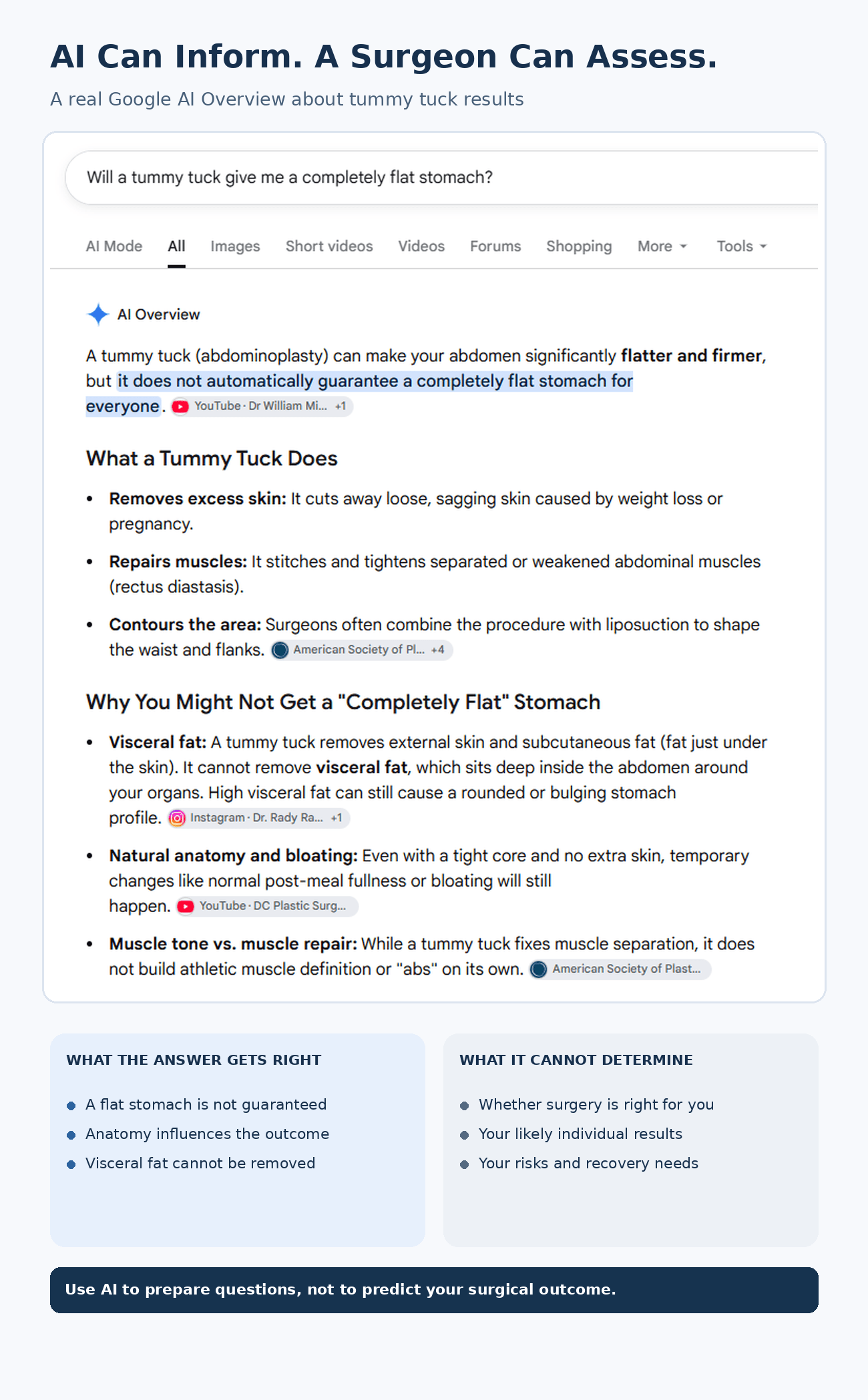
An example of Google’s AI Overview providing useful information about tummy tuck results while demonstrating why individual surgical assessments remain essential.
Tummy Tuck Results: Understanding What’s Possible and What’s Not
A tummy tuck, medically known as abdominoplasty, is designed to improve abdominal contour by removing excess skin and fat and, when appropriate, repairing or tightening the abdominal wall.
According to the American Society of Plastic Surgeons’ guidance on tummy tuck results, the procedure can create a flatter, firmer abdominal profile that is more proportionate to a patient’s body type and weight. However, no specific cosmetic outcome can be guaranteed.
A tummy tuck may be particularly beneficial for individuals with loose abdominal skin following pregnancy or significant weight changes.
However, it is not a weight-loss procedure, and it cannot address every cause of abdominal fullness.
Several factors influence the results.
Your abdominal anatomy: Natural skeletal structure, muscle positioning, and body proportions affect the shape of your abdomen.
Visceral fat: Fat located around internal organs cannot be removed through abdominoplasty or conventional liposuction.
Skin quality: Skin elasticity, stretch marks, and existing tissue characteristics influence the appearance of your abdomen after surgery. Stretch marks may remain unless they are located within skin that is removed.
Muscle separation: Abdominal muscle separation, often called diastasis recti, may contribute to abdominal protrusion. Repair may be included when appropriate, but not every patient requires it.
Scarring and healing: Abdominoplasty creates permanent surgical scars. Swelling, tissue healing, and scar maturation can influence how your results appear over time.
A flatter, firmer abdomen may be achievable, but a completely flat stomach is not guaranteed.
The goal should be an improvement that is realistic for your body rather than an exact reproduction of a photograph or an AI-generated description.
Mommy Makeovers: Why Results Differ Between Patients
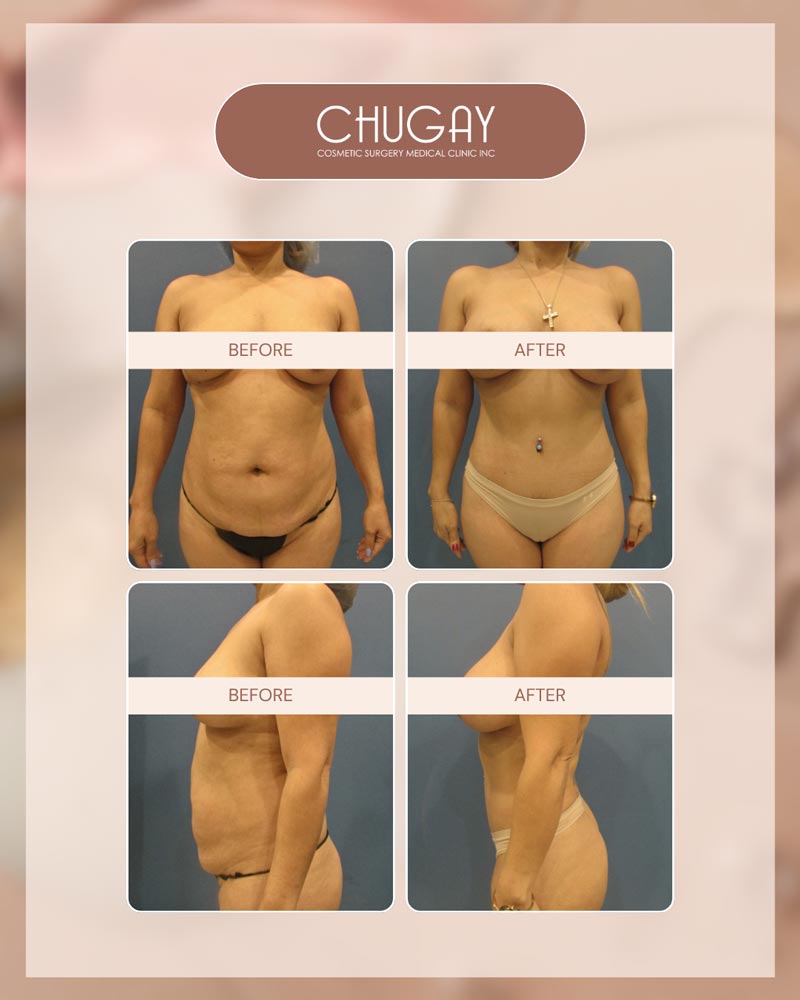
A mommy makeover is not one standardized surgical procedure.
It generally refers to a personalized combination of cosmetic procedures intended to address physical changes associated with pregnancy, childbirth, breastfeeding, aging, or weight fluctuations.
Depending on your goals and individual anatomy, a mommy makeover may include:
Not every patient needs all of these procedures, and combining surgeries is not appropriate for everyone.
This is particularly important when researching mommy makeover results online.
One patient’s transformation may involve a tummy tuck and breast lift. Another may have undergone abdominal surgery, breast augmentation, and liposuction.
Although both procedures are described as mommy makeovers, the results, recovery experiences, and surgical risks can be substantially different.
Additionally, a mommy makeover cannot guarantee the restoration of your exact pre-pregnancy appearance.
Natural anatomy, tissue changes, previous pregnancies, weight fluctuations, and individual healing all influence outcomes.
A personalized surgical plan should be based on your anatomy, health, goals, and an informed discussion of the available options.
Can You Trust Before-and-After Images Found Online?
Before-and-after photographs can be useful when researching cosmetic surgery, but they deserve careful consideration.
Advances in artificial intelligence and photo-editing technology make it increasingly easy to generate realistic-looking images or significantly alter existing photographs.
Even authentic patient photographs can provide only a limited representation of the complete surgical outcome.
Before relying on cosmetic surgery images, consider these five questions.
1. Are These Photographs of Real Patients?
Look for images clearly identified as actual patient results rather than AI-generated illustrations, digital simulations, or artist renderings.
If the source is unclear, avoid treating the image as evidence of what surgery can accomplish.
2. Do the Images Accurately Represent Surgical Results?
Before-and-after photographs can help illustrate the improvements cosmetic surgery may achieve. However, it’s important to distinguish genuine patient results from digitally generated or significantly altered images.
Remember that photographs capture one moment in a patient’s recovery and may not fully reflect the appearance, texture, or natural movement of the treated area.
Use these images as examples of possible improvements rather than exact predictions of your own results.
3. How Long After Surgery Were the Photographs Taken?
Swelling and healing continue after surgery. Scars can also change considerably over several months or longer.
An early postoperative photograph does not necessarily represent the final result.
4. Which Procedures Were Performed?
A patient whose abdomen appears significantly improved may have undergone both abdominoplasty and liposuction.
Similarly, a mommy makeover transformation may reflect several different procedures.
Knowing what was performed is essential to understanding the outcome.
5. Does the Patient Have Similar Starting Anatomy?
Even when two patients undergo the same surgery, their results may differ because of body proportions, skin elasticity, fat distribution, and other individual characteristics.
Before-and-after photographs should illustrate possible results, not promise identical outcomes.
You can also explore our real patient before-and-after gallery. Individual results vary.
Why AI Recovery Timelines Can Be Misleading
Another common use of AI is researching how long recovery takes after cosmetic surgery.
An AI tool may provide a general timeline for returning to work, exercising, or resuming everyday activities.
Although general timelines can be useful, they may not reflect your personal recovery needs.
For example, tummy tuck recovery depends on the extent of the procedure, whether muscle repair is performed, other procedures completed at the same time, and individual healing factors.
Patients may experience swelling, discomfort, reduced mobility, and temporary activity restrictions. Some may require surgical drains or compression garments.
It may take several weeks to resume many activities, while swelling and scar maturation can continue for months.
Combined mommy makeover procedures may involve additional recovery considerations.
Surgical risks also need to be understood.
The American Society of Plastic Surgeons outlines potential tummy tuck complications, including bleeding, infection, fluid accumulation, poor wound healing, unfavorable scarring, blood clots, and anesthesia-related complications.
Breast augmentation carries its own risks, including capsular contracture, implant rupture, infection, and the possibility of future surgery.
The U.S. Food and Drug Administration explains that breast implants are not lifetime devices, and additional procedures may become necessary because of complications or changes over time.
An AI-generated recovery estimate should never be interpreted as a guarantee.
Your surgeon’s postoperative instructions and individual medical advice should guide your recovery.
Five Ways to Evaluate AI-Generated Cosmetic Surgery Information
AI can be a valuable research tool when used thoughtfully.
Here are five practical ways to evaluate the answers you receive.
1. Check the Original Sources
An AI-generated answer may reference reputable medical organizations, but that does not automatically mean every statement accurately reflects those sources.
Whenever possible, open the original references and verify the information.
The National Library of Medicine’s guide to evaluating health information recommends examining where medical information comes from, who is responsible for it, whether it is current, and how it is supported.
Good starting points include the American Society of Plastic Surgeons, the U.S. Food and Drug Administration, peer-reviewed medical publications, and established medical institutions.
2. Question Absolute Claims
Be cautious when an answer promises a particular result or presents surgery as having no meaningful limitations.
Statements such as “A tummy tuck guarantees a flat stomach” or “A mommy makeover restores your exact pre-pregnancy body” are not reliable expectations.
No cosmetic surgery can guarantee a specific aesthetic result.
3. Ask About Limitations and Risks
Instead of asking AI only what a procedure can accomplish, ask what it cannot accomplish.
For example:
“What anatomical factors could prevent someone from achieving a completely flat abdomen after a tummy tuck?”
Or:
“What are the risks and limitations of combining breast augmentation and a tummy tuck?”
These questions can produce more balanced information and help you prepare for a consultation.
4. Examine Images and Results Carefully
Verify that before-and-after photographs represent actual patients, identify the procedures performed, and consider whether the results are relevant to your own anatomy.
Do not assume an image displayed by a search engine represents a typical or guaranteed outcome.
5. Discuss Your Findings With a Qualified Surgeon
Bring your research, questions, and any conflicting information to your consultation.
Ask what improvements may be achievable for your body, what risks apply to you, whether alternatives exist, and how recovery may affect your normal activities.
A consultation helps translate general information into medical guidance relevant to your circumstances.
What AI Cannot Replace: An Individual Surgical Consultation
Artificial intelligence has made information about cosmetic procedures more accessible, and that can be a positive development when the information is accurate and properly understood.
However, even the best AI-generated explanation cannot replace a detailed medical history, physical examination, and clinical evaluation.
At Chugay Cosmetic Surgery in Long Beach, California, we encourage patients to research their options, ask questions, and develop realistic expectations before making decisions about elective surgery.
Whether you are considering a tummy tuck, mommy makeover, liposuction, or breast augmentation, understanding both the potential benefits and limitations is essential.
The most important question isn’t simply “What results can this procedure achieve?” It’s “What results are realistic and medically appropriate for me?”
Take the Next Step With Confidence
If you’re considering a tummy tuck or mommy makeover, a personal consultation can help you better understand your available options.
Contact Chugay Cosmetic Surgery to schedule a consultation and discuss your goals, potential surgical approaches, risks, and expected recovery.
Call our Long Beach office at (562) 595-8507.
Medical Disclaimer: This article is intended for general educational purposes and does not constitute individual medical advice. Cosmetic surgery involves risks, and results vary among patients. A qualified medical professional should evaluate your health, goals, and suitability before any procedure.
Medically Reviewed by: Dr. Paul Chugay, MD
Date of Medical Review: October 29, 2026